Silver-containing Inorganic
Antibacterial Agents
Discoloration Resistance Performance
Light Resistance Test Method
【Evaluation Methods】
Antibacterially treated products are used not only indoors but also in outdoor environments. Products installed outdoors are particularly susceptible to ultraviolet (UV) and infrared (IR) radiation from sunlight, which can cause rapid changes in appearance and material deterioration. Therefore,
excellent discoloration resistance is a critical factor in selecting suitable antibacterial agents.
In this test, a solar weathering tester is used to artificially irradiate light, and samples are exposed to
light to evaluate the color change of antibacterially processed products in a short time.
【Test Conditions】
・ UV carbon arc lamp 254 nm
・ UV intensity: 3500 μW/cm²
* Test results shown are representative and are not guaranteed.
【Evaluation Criteria】
Color change is visually evaluated after irradiation.
PP Plate
A PP plate with 0.5% AW added showed no discoloration even after one week of UV irradiation. In contrast, discoloration was observed in a PP plate containing a competing antibacterial agent (containing a silver compound not metallic silver). Apacider AW effectively maintained the attractive appearance of the sample product.
PP Plate
| Test Sample | Before Irradiation | After 1 Week of Irradiation |
|---|---|---|
| AW 0.5% |
|
|
| Competing Antibacterial Agent (Silver Compound-Based) |
|
|


Nylon Fiber
Nylon fibers with 0.5% AK added showed no discoloration even after one week of UV irradiation. In contrast, discoloration was observed in nylon fibers containing a competing antibacterial agent (containing a silver compound not metallic silver).
AK effectively maintained the attractive appearance of the product.
Nylon Fiber
| Test Sample | Before Irradiation | After 1 Week of Irradiation |
|---|---|---|
| AK 0.5% |
|
|
| Competing Antibacterial Agent (Silver Compound-Based) |
|
|


Discoloration Resistance Test Under Food Contact Conditions
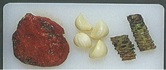
Antibacterially treated products are used not only in general industrial applications but also in kitchen utensils and packaging materials that come into direct contact with food. Typical examples include plastic cutting boards, sponges, drain bags, and film wrap materials. Among these, plastic cutting boards are especially prone to frequent contact with food and are highly susceptible to microbial growth on their surfaces, such as bacteria and mold. The presence of microorganisms, and some antibacterial additives themselves, can lead to discoloration and a deterioration in the product’s appearance. Therefore, when selecting an antimicrobial agent, both excellent antimicrobial performance and resistance to discoloration are required.
PE Cutting Board
A cutting board with 0.5% AW added showed no discoloration caused by mold or other microorganisms even after one week of food contact. In contrast, discoloration was observed on a cutting board containing competing antibacterial agent (containing a silver compound not metallic silver). AW effectively maintained the clean appearance of the product surface.
PE Cutting Board
| Test Sample | After 1 Day | After 3 Days | After7 Days | Result |
|---|---|---|---|---|
| AW 0.5% |
|
|
|
|
| Competing Antibacterial Agent (Silver Compound-Based) |
|
|
|
|